Simple RSI Strategy - Rule Based Higher Timeframe Trading
ลิงก์ TradingView

คำอธิบาย
HOW IT WORKS
With the default settings, the strategy buys when RSI reaches 30 and closes when RSI reaches 40 .
That’s it.
A simple, rule-based mean reversion strategy designed for higher timeframes , where market noise is lower and trading becomes easier to manage.
Core logic:
Long when RSI moves into oversold territory
Exit when RSI mean-reverts upward
Optional short trades from overbought levels
One position at a time (no pyramiding)
No filters.
No discretion.
Just clear, testable rules.
MARKETS & TIMEFRAMES
This strategy is intended for:
Indices (Nasdaq, S&P 500, DAX, etc.)
Liquid futures and CFDs
Higher timeframes: 2H, 4H and Daily
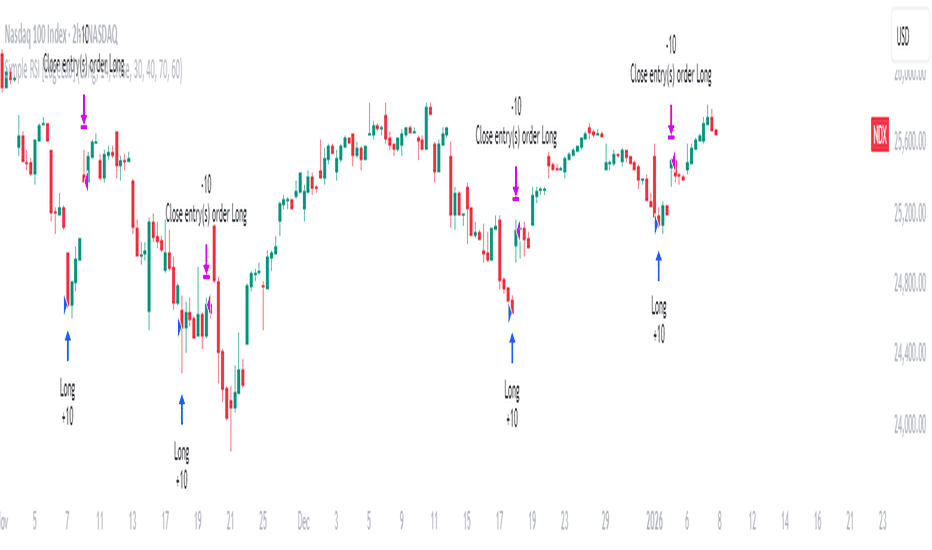
The published example is Nasdaq (NDX) on the 2-hour timeframe .
Higher timeframes are strongly recommended.
HOW TO USE IT
Apply the strategy on a higher timeframe
Adjust RSI levels per market if needed
Use TradingView alerts to avoid constant screen-watching
Focus on execution, risk control, and consistency
This strategy is meant to be a building block , not a complete trading business on its own.
For long-term consistency, it works best when combined with other uncorrelated, rule-based systems.
IMPORTANT
This is not financial advice
All results are historical and not indicative of future performance
Always forward-test and apply proper risk management
For additional notes, setups and related systems, visit my TradingView profile page .
รูป Preview
Pine Script Source
//@version=6
strategy(
     "Simple RSI [EdgeLab]",
     overlay = true,
     initial_capital = 100000,
     default_qty_type = strategy.percent_of_equity,
     default_qty_value = 100,
     pyramiding = 0,
     process_orders_on_close = true,
     margin_long = 0,
     margin_short = 0)

//────────────────────
// Inputs (tooltips show as the little "i" icon)
//────────────────────
dir = input.string(
     "Long",
     "Trade Direction",
     options = ["Long", "Short", "Both"],
     tooltip = "Choose which trades the strategy is allowed to take:\n• Long = buy signals only\n• Short = sell signals only\n• Both = long and short signals",
     group = "General")

len = input.int(
     14,
     "RSI Length",
     minval = 1,
     tooltip = "How many bars the RSI calculation uses.\nHigher = smoother/slower signals.\nLower = faster/more signals.",
     group = "General")

src = input.source(
     close,
     "RSI Source",
     tooltip = "Which price the RSI is calculated from.\nClose is the most common choice.",
     group = "General")

// Long levels
entryL = input.int(
     30,
     "Long: Enter when RSI ≤",
     minval = 1,
     maxval = 99,
     tooltip = "Long entry trigger.\nWhen RSI drops to this level or lower, the strategy opens a LONG.\nLower value = fewer entries (more 'oversold').",
     group = "Long")

exitL = input.int(
     40,
     "Long: Exit when RSI ≥",
     minval = 2,
     maxval = 100,
     tooltip = "Long exit trigger.\nWhen RSI rises to this level or higher, the strategy closes the LONG.\nHigher value = holds longer before exiting.",
     group = "Long")

// Short levels
entryS = input.int(
     70,
     "Short: Enter when RSI ≥",
     minval = 1,
     maxval = 99,
     tooltip = "Short entry trigger.\nWhen RSI rises to this level or higher, the strategy opens a SHORT.\nHigher value = fewer entries (more 'overbought').",
     group = "Short")

exitS = input.int(
     60,
     "Short: Exit when RSI ≤",
     minval = 1,
     maxval = 99,
     tooltip = "Short exit trigger.\nWhen RSI drops to this level or lower, the strategy closes the SHORT.\nLower value = holds longer before exiting.",
     group = "Short")

// Direction flags
allowLong  = dir == "Long" or dir == "Both"
allowShort = dir == "Short" or dir == "Both"

//────────────────────
// RSI
//────────────────────
r = ta.rsi(src, len)

//────────────────────
// Entry / exit conditions (enter only on first cross of level)
//────────────────────
// Long
enterLong = allowLong and ta.crossunder(r, entryL) and strategy.position_size == 0
exitLong  = allowLong and ta.crossover(r, exitL) and strategy.position_size > 0

// Short
enterShort = allowShort and ta.crossover(r, entryS) and strategy.position_size == 0
exitShort  = allowShort and ta.crossunder(r, exitS) and strategy.position_size < 0

//────────────────────
// Orders
//────────────────────
if enterLong
    strategy.entry("Long", strategy.long)

if exitLong
    strategy.close("Long")

if enterShort
    strategy.entry("Short", strategy.short)

if exitShort
    strategy.close("Short")

//────────────────────
// Alertconditions (for "Create Alert" dialog)
//────────────────────
alertcondition(enterLong,  "Enter Long",  "Enter LONG: RSI crossed down into the long entry level.")
alertcondition(exitLong,   "Exit Long",   "Exit LONG: RSI crossed up into the long exit level.")
alertcondition(enterShort, "Enter Short", "Enter SHORT: RSI crossed up into the short entry level.")
alertcondition(exitShort,  "Exit Short",  "Exit SHORT: RSI crossed down into the short exit level.")